Showing posts with label wild mushrooms. Show all posts

Monday, September 19, 2022

Fabulous Time at the Foraging and Feasting Workshop at Frick Park


Yesterday at Frick Park we had a fabulous time at our Fall  Foraging and Feasting Workshop! Fourteen lovely people plus one adorable baby joined us as we took a walk around the park discussing edible and medicinal uses of common plants, then foraged wild greens, flowers, and herbs to add to our lunch. We made our own wild herbal butters (we used vegan butter) by mixing plants like wood sorrel, goldenrod flowers, smartweed flowers, ground ivy, Asiatic dayflowers, and herbs growing at the center: basil, chives, rosemary, thyme, mint (each participant got to choose their own combination!)


Then they cooked their own bread over a fire:


...while I added the wild greens and herbs to our delicious vegan White Bean Potato Lentil Soup:


I added goldenrod leaves, dayflower leaves, wood sorrel leaves, chives, rosemary, and the rest of the goldenrod flowers that we harvested for the butter. The beauty of a soup like this (or any soup which has "spinach" as an ingredient) is that instead of the spinach, you can add any wild greens that are in season. I'll include the recipe below.

It was such a fantastic day! Some of the plants (and mushrooms) we saw and discussed were:

Edible/Herbal Plants:
  • Wild Carrot/Queen Anne's Lace (Use caution! has poison look alikes including Poison Hemlock, Water Hemlock, and White Snakeroot)
  • Boneset (Use with the utmost of caution! Poison look-alike is White Snakeroot)
  • Goldenrod
  • Wood sorrel
  • Plantain (Plantago major)
  • Lambs Quarters
  • Purslane
  • Ground Ivy/Creeping Charlie
  • Broad-leaf dock leaves and seeds
  • Mugwort
  • Asiatic Dayflower
  • Smartweed
  • Deadnettle
  • Acorns
  • Black Walnut
Edible/Herbal Mushrooms included:
  • Turkey tail
  • Various boletes
  • Various polypores
  • Aborted entoloma
Poisonous/Non-edible/Allergen Plants Included:
  • White snakeroot (poison)
  • Pokeweed/Pokeberries (poison, though earliest shoots are edible in spring, properly prepared)
  • Ragweed (common allergen)
We identified and discussed various trees:
  • Black Walnut
  • Oaks, distinguishing white oaks from red/black
  • Tulip poplar
Herbs growing at center:
  • Thyme
  • Basil
  • Chocolate Mint
  • Rosemary
  • Chives

As you can see we had a busy day of discovery, fun, learning, and feasting!

Recipe for White Bean Potato Soup: (gluten-free, oil-free, vegan)

I will tell you the ingredients I used, but I was cooking for 20 people, so I won't share the amounts! You'll have to use your judgment when making the soup. It is a thick creamy soup though, so don't skimp on the beans and potatoes!

I used an instantpot and dried beans for this recipe, cooking the (unsoaked) beans first for about 45 minutes, then adding the rest of the ingredients and cooking for 15 more. I added the red lentils with the vegetables for the second cooking, since they do not take as long to cook as white beans and chickpeas. You can use canned beans, in any combination, even choosing to use all white beans. I'll share a secret: I only added the chickpeas and red lentils because I ran out of white beans. But the red lentils really added a lot to the soup, and took the flavor to the next level, so if you have them, I would recommend using them.

Ingredients:
  • white beans, I used dry, you can use canned
  • chickpeas (aka garbanzo beans), I used dry, you can use canned
  • red lentils (dry)
  • onion (I used red onion because it's what I had)
  • garlic
  • celery
  • carrot
  • Better Than Bouillon, seasoned vegetable base
  • Potatoes (I used yellow because it's what I had, you can use any kind)
  • Salt and pepper to taste
  • Seasonal wild greens, herbs, and flowers of your choosing! We used: goldenrod leaves and flowers, smartweed greens, Asiatic dayflower greens, wood sorrel, deadnettle, lambsquarters
Directions:

  1. In an instant pot/pressure cooker: cook white beans and chickpeas for 45 minutes on high pressure. If you don't have an instant pot, you can use canned beans or soak the beans overnight and cook on stove for half an hour before adding other ingredients.
  2. Add all other ingredients except wild greens with just enough water to cover. Cook 15 more minutes. If you don't have a pressure cooker, cook until potatoes and carrots are soft.
  3. When finished cooking, use a potato masher to mash enough of the beans and potatoes to make the soup nice and creamy.
  4. Add the wild greens, herbs, and flowers while soup is still hot. Cook at least 5 more minutes until greens are wilted.
  5. Season to taste.
  6. ENJOY!


Please join me on patreon where I will be adding slides and information of all the wild plants we saw over the next few weeks.

Hope you are enjoying the fall!

~ Melissa

Thursday, April 27, 2017

Wild Dinner: Garlic Mustard and Cleavers Pesto with Dryad's Saddle


wild mushroom
Dryad's Saddle (Polyporus squamosus)
Sometimes when I'm out looking for morels, I don't find any morels. If I'm lucky, I will find Dryad's Saddle (aka Pheasant Back, aka Polyporus squamosus.) If it's early enough in the season they will be tender and juicy and delicious. I'm happy to report that was the case today.

Also while out looking for morels, I passed piles of (weeded) garlic mustard, but I also passed fields of it where the volunteers hadn't yet reached.

flowering garlic mustard
Garlic Mustard (Alliaria petiolata)

So I thought, "You know what would make a nice dinner...."

So even though I didn't find morels, I returned home with a bag full of Dryad's Saddle, garlic mustard, and some cleavers, which is a delicious fresh spring green (yay!) with the texture of sandpaper (boo!), but blended into pesto it is quite nice.

cleavers
Cleavers (Galium aparine)

cleavers stuck to sweater
Demonstration of how cleavers use their sandpaper-like texture to stick to you.
I like to cut the pungent taste of garlic mustard with a less bold green: cleavers and chickweed (Stellaria media) are top on my list this time of year.

Recipes:

Garlic Mustard and Cleavers Pesto:

Ingredients:

  • 2 cups greens (I used mostly garlic mustard with a bit of cleavers)
  • 2 cloves garlic
  • 1/4 cup walnuts: dry roasted then splashed with lemon juice and tamari at end of cooking
  • 2+ Tbsp olive oil
  • salt
  • lemon juice
  • nutritional yeast (optional, but nice addition if not using Parmesan cheese)

Directions:

  1. In a food processor, first process garlic into small pieces.
  2. Dry roast walnuts in iron pan until just start to smoke and turn brown. Turn off heat and add a splash of lemon juice and tamari, stir quickly to coat all the walnuts.
  3. Add walnuts to processor and pulse a little.
  4. Add greens in batches with oil and pulse until blended.
  5. Add lemon juice, salt, nutritional yeast to taste, pulse until blended.


pesto

Mix in to favorite pasta and enjoy.

pesto pasta


Side of Dryad's Saddle:

Cut the dryad's saddle thinly, then saute in butter or oil until browned (stir or flip so both sides cook.)

cooked wild mushroom

And serve:

mushrooms and pasta

Enjoy the wilds of spring!

Happy Foraging,

Melissa

Tuesday, April 25, 2017

Finding Morels By Following A Trail of Tulip Poplar Petals


April 24 is my wedding anniversary! It has become a tradition for me and Dave to look for morels on our anniversary. This year was no exception and our search was not in vain.

I thought I'd share with you a tip on how we hone in on where to look for morels, so I made the little video (above). We love looking for morels around tulip poplar trees. Tulip poplars are great big trees that grow straight up for a long time before you see branches. Their leaves' shape always reminds me of pokeman. So when I'm walking around looking down (to find mushrooms) and I start seeing petals from the flowers way on top of the tulip poplar trees, I know I'm in a good area.

tulip poplar flower
Photo by Bruce Marlin, Wikimedia Commons
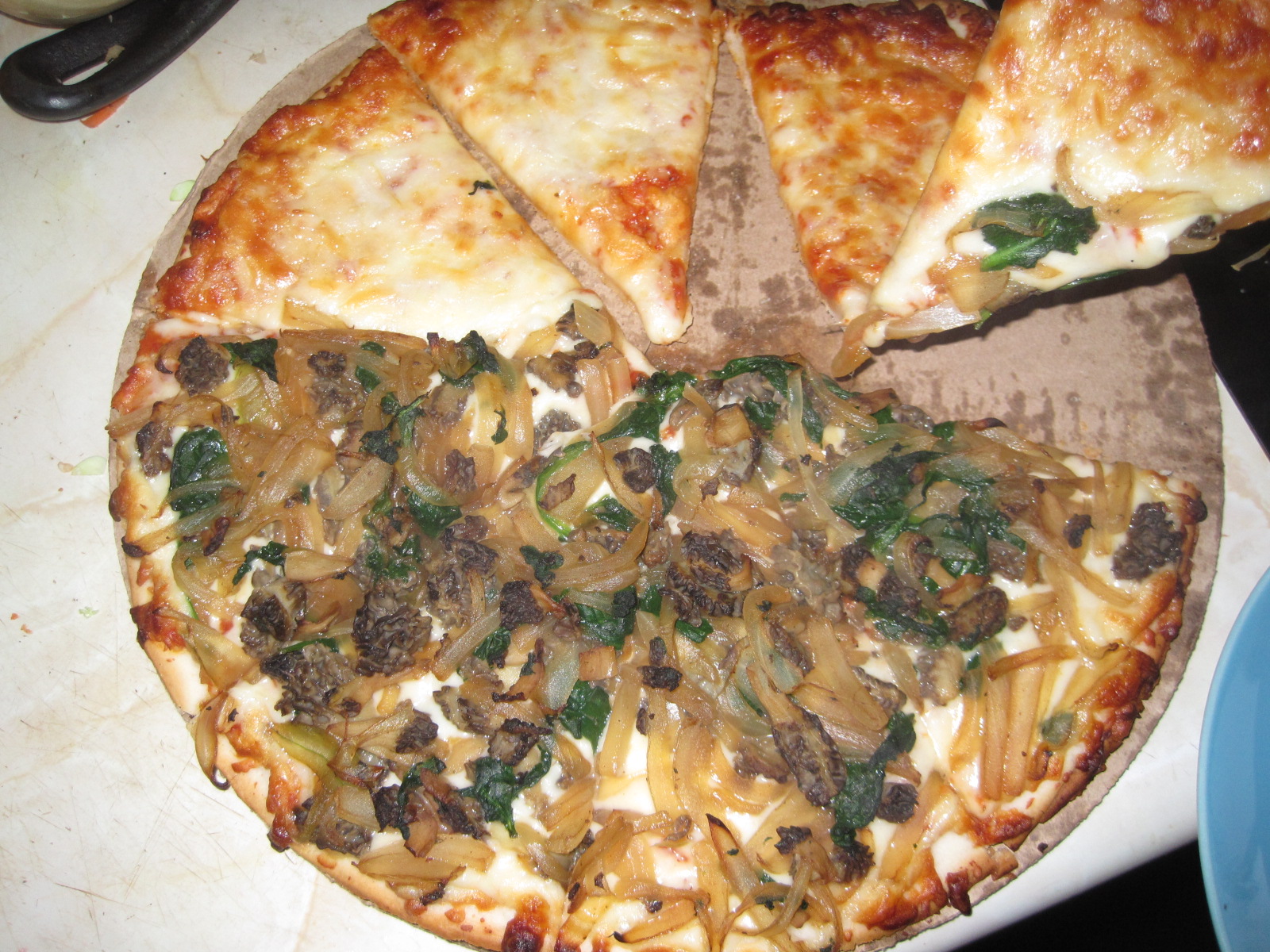
Today we found a bunch of morels. I sauteed them with onions and spinach, then topped our pizza with them (only half the pizza, as my daughter doesn't like morels...!)

morel mushroom

pizza

pizza slice

Hope you are able to get out into the woods and find some morels of your own!

~ Melissa

Wednesday, October 19, 2016

Recipe: Puffball Nuggets

puffball mushroom
Calvatia gigantia - Giant Puffball Mushroom
 Giant Puffball! So exciting and fun to find!!

girl holding puffball


Here is my friend Trish last year on our bike to DC, finding some:

woman with puffball

And yet, with their marshmallow-like inside, the texture when cooked (sauteed) is not the best. Sort of mushy and lackluster...not really my favorite mushroom. 

That is, until today!

breaded puffball nuggets

I found if you put the crunch on the outside, it doesn't matter so much if it's soft on the inside. In fact, it's better that way!

Because I am doing a vegan oil-free type diet right now (a la Forks Over Knives) I knew I didn't want to saute these in oil or butter. But what else could I do?

That's when the old noggin took over and voila, deliciousness was born. These are such tasty puffball nuggets I am hoping I find more out there this season!

Recipe: Puffball Nuggets

vegan, gluten-free, oil-free

1. Preheat oven to 375 F.

2. Get two bowls. In one, put tamari (gluten-free soy sauce) and water in equal amounts. In the second, make the "breading."

Breading 1


  • rice chex-type cereal
  • nutritional yeast
  • black pepper
  • dried basil
  • dried thyme
  • dried parsley
  • dried cilantro


Crush the cereal and mix everything together. You can add or omit spices as you have them or to your taste. I did not put salt in because the tamari is salty.

Breading 2:


  • blue corn chips 
  • nutritional yeast
  • cumin
  • tumeric
  • dried coriander
  • chili powder
  • cayenne pepper


Again, mix and match spices as you like. I was going for a Mexican theme with the corn chips. You can also use yellow or white corn chips. Crush corn chips (I used a spice/coffee grinder) and mix with spices and nutritional yeast.

3. Now, take your puffball:


  • Slice it 
  • Peel it (peel the outer skin away from the marshmallow-y inside, it easily comes off, but you can also cut it off if you want. I peel each slice rather than trying to peel the whole mushroom before I've cut it!)
  • Cut it into "nugget" or "finger" sized pieces


4. Take each piece and first dip into the tamari mixture:

cut mushroom

5. Then dip it into breading:
mushroom and breading
6. Place onto a tray covered with parchment paper:

mushrooms on tray

7. Bake 18 minutes, flip pieces over and bake another 15 minutes.

8. Enjoy!!! You will! They are so good!!

I preferred Breading 1:

breaded nuggets
While my husband preferred Breading 2:

breaded nuggets
Now... to find more giant puffballs!
woman with mushroom
Happy foraging!

~ Melissa

Monday, October 17, 2016

October is A Month of Wild Abundance

wild mushrooms
Gem-Studded Puffballs

October is amazing when it comes to finding wild food!

The forests are full of delicious mushrooms including giant puffballs, pear shaped puffballs, gem studded puffballs, chicken mushrooms, hen of the woods, aborted entaloma (shrimp of the woods), blewits, honey mushrooms, lion's mane, ... what else am I forgetting? Parasol mushrooms, horse mushrooms, at a mushroom club walk on October 15 even chanterelles were found! Abundant!!

table of wild mushrooms
Just some of the mushrooms found at the Western PA Mushroom Club's walk on Saturday October 15
 Mushrooms aside (though it is difficult to put mushrooms aside - they are so delicious!), there are other delights found in October as well.

You might have noticed these gorgeous sunflowers blooming along roadsides or in fields and forests.
sunflowers

They are the native American sunchoke (aka Jerusalem artichokes.) Sunchoke (Helianthus tuberosus) are in the sunflower family, though this species is not known as much for its seeds as for its underground tubers (hence the species name tuberosus.)

sunchokes
sunchoke tubers
The tubers are knobby and funny looking, but they are delicious, abundant, easy to dig, and nutritious. They can be eaten raw, steamed, boiled, roasted, fried, simmered. Ways to make them include: roast them alongside other root vegetables like potatoes, sweet potatoes, parsnips, and carrots. Steam and mash like mashed potatoes. Saute with mushrooms (maybe some aborted entolomas or other wild mushroom). Make into a delicious soup (recipe will be posted tomorrow.)

black walnut
black walnut in its green husk
Other October treats include nuts such as black walnut and hickory nuts. Now is definitely the time to get out and collect those, as well as acorns, which are falling off trees in droves this time of year. Unlike black walnut and hickory, most acorns need to be processed first to remove the bitter tanins. In the past I have boiled shelled acorns in repeated changes of water, but this year I am going to try a method described in Mike Krebill's new book Scout's Guide to Edible Wild Plants (due out November, 2016 and on which I was technical editor), where he blends the acorn meet in the blender, and then rinses the pulp until the bitterness is gone. I will report back in more detail once I actually try it.
kousa dogwood fruit
kousa dogwood
You may have noticed these red balls hanging from some of your dogwood trees: this is Kousa dogwood, and the inside of this red fruit is soft, creamy and delicious.
kousa dogwood fruit

Foraging is fun, and especially so in October! I hope you are able to get out there and find an abundance of wild food!

~ Melissa

Monday, October 10, 2016

Hot Wings from Chicken Mushrooms

chicken mushrooms
Chicken Mushroom, Laetiporus sulfureous


Chicken wings were a big part of my teenage years. Even though Syracuse, New York is not Buffalo, my friends and I saw our fair share of hot chicken wings in the 80's.

I even worked at a fast food chicken joint in the 80's and learned the secret hot sauce recipe:
  • Hot: 3 parts Tabasco to 1 part butter*
  • Medium: equal parts Tabasco and butter
  • Mild: 1 part Tabasco to 3 parts butter
*now of course Earth Balance or another vegan butter replacement can be substituted to make it vegan

But all that was long lost since going vegetarian in 1987. And though I did not miss the stringy veiny chicken wings, that sauce....oh, that sauce.

Then I started finding vegetarian "chicken" wings made from seitan (wheat gluten) and I was so happy! They were delicious and all I could hope for. Except for the wheat. Since being gluten-free I've had to give up those and THOSE I dearly miss.

I don't know why it didn't occur to me earlier, but suddenly this was the year that I thought to use chicken mushroom and try to make those wings. Maybe because I never actually made wings or seitan "wings" myself before (aside from lowering wings into the fryer at the fast food place, then tossing them in a bucket to shake on the sauce. I've never deep fried anything in my own home.)

"You can use chicken mushroom in any recipe that calls for chicken," I've seen written and heard said.

And so....

cooked mushrooms and celery
Sliced Chicken Mushroom made into Hot Wings, with celery

Wonderful! Heavenly! Spicy nirvana!

I simply sliced and sauteed the chicken mushroom in olive oil (adding salt), then melted some butter (you can use a vegan butter substitute such as Earth Balance) and mixed in an equal amount of hot sauce (alas, we had no Tobasco at home so I used Frank's hot sauce), and tossed the mushrooms in the hot sauce at the end of cooking.

This is definitely a keeper.
~ Melissa

Sunday, October 9, 2016

Fall Mushrooms are Filling the Woods (and our Table!)

Fall is such an excellent time for mushroom hunting! The woods are full of blooms of delicious wild mushrooms. Yesterday and today we went out hiking and found a plethora of mushrooms.

Yesterday's haul:

wild mushrooms
Clockwise from the top: 
Hen of the woods, Lion's Mane, chicken mushroom, gem studded puffballs, pear shaped puffballs.


Today's haul:

chicken mushroom and aborted entoloma
Chicken Mushrooms and Aborted (or Abortive) entoloma

Yesterday we had fun thinly slicing and cooking up each mushroom one by one, to sample them all. We cooked them all the same: saute in olive oil and butter, with salt and pepper. 

lion's mane mushroom
lion's mane - Hericium erinaceous

cooking mushrooms
lion's mane beginning to brown

wild mushrooms
gem studded puffballs - Lycoperdon perlatum
mushrooms in pan
chicken mushroom - Laetiporus sulfureus

hen mushrooms in pan
hen of the woods/maitake (Grifola frondosa)
They were all so different and delicious, though the puffball wasn't universally loved because of its lack of texture. However, cutting them thin and cooking until crispy made them very appetizing to me!
chicken musrhooms

Today with our much larger haul of chicken mushrooms, I made "Hot Chicken Wings" (post to come), which is basically thinly slicing and sauteing the mushrooms in butter/oil (and steaming a bit with water, making sure they are cooked through.) When done cooking I added melted butter and hot sauce in equal amounts for spicy chicken mushroom "wings."

These we had on corn tortillas over mashed potatoes, topped with lettuce and tomato. Very delicious.

We will enjoy the Abortive entoloma (Entoloma abortivum) tomorrow!

Happy Fall!!

~ Melissa


Saturday, October 8, 2016

Recipe - Hen of the Woods Chili

hen of the woods mushroom growing by tree

Today I took a lovely walk in the woods and found a basketful of edible mushrooms. I will talk about what we found (and then sampled) tomorrow, but today I wanted to share a delicious recipe for Hen-of-the-Woods (Maitake) Chili.

Hen of the Woods (Grifola frondosa), also known as Maitake, is a delicious edible and medicinal fall mushroom. It can sometimes be hard to spot (can you see it in the picture above?) They are often found at the base of oak trees.

Today I found a couple of small ones which normally I would have left to grow, but I'm not sure when I'll be able to get back (or if I could find my way back to where I was in the middle of the woods!) so I went ahead and picked them.

wild mushroom on tree

Even though the ones I found were small, they were certainly enough to make chili out of! Here is one of my favorite chili recipes using this mushroom. Enjoy!

mushroom chili

Hen of the Woods Chili (Vegan and Gluten-free)

Ingredients:
  • 2 - 4 cups Hen of the Woods Mushroom, chopped into bite sized pieces 
  • 1 chopped onion
  • 2 cloves chopped garlic
  • 1 chopped jalapeno pepper (or bell pepper if you don't like spice, or omit)
  • 2 chopped celery stalks
  • 1 can kidney beans
  • 1 can black beans (or use your own soaked and cooked beans!! Any kind you like for chili. I was being lazy.)
  • a bunch of tomatoes blended in your high powered blender, (or a can/jar of tomato sauce) - we still have lots of tomatoes from our garden! So I've been blending them in the Vitamix and cooking them down into sauce or putting in soups. With the vitamix you don't need to worry about peeling them :-D
  • 1 - 2 Tbsp chili powder
  • 1 Tbsp dried basil
  • 1 tsp cumin powder
  • salt, pepper
  • olive oil, for sauteing
  • 3 - 4 cups water (or broth...I just used water.)
Method

In a big pot: saute the hen of the woods, onions, garlic, pepper and celery in olive oil. Add some salt while cooking. I actually cooked the hen a bit first so it could release its water and cook a bit. 

Next add the spices (chili powder, cumin and basil).

Once the onions are cooked and translucent add beans, blended tomatoes, and water.

Let it simmer to blend the flavors. Adjust salt, pepper and seasonings to taste. Let cook at least 45 minutes to an hour. 

It's often even better the next day.

I served it over brown rice with a little hot sauce.

Enjoy!! :-)

Monday, August 22, 2016

The Hunt For Wild Mushrooms

This article first appeared in the East End Food Cooperator in August, 2012. I've added the pictures below.

The Hunt for Wild Mushrooms
by Melissa Sokulski
morel mushrooms
Morels, early spring

Mushrooms are an interesting entity: neither plant nor animal, fungi are their own kingdom and upon close examination actually have more in common with animals than plants. Their cell walls contain chitin, found in shells of crabs and exoskeletons of insects but absent from plants. Plants make their own food but like animals fungi digest their food with enzymes they produce. Fungi also take in oxygen and release carbon dioxide like animals, while plants do just the reverse.

Nevertheless, as a vegetarian I am comfortable eating mushrooms and wild mushrooms are a true culinary delight - a feast for the forager - if you know what you are looking for.
When my husband and I first decided to learn about wild mushrooms, we were extremely fortunate to stumble upon the amazing and generous Western Pennsylvania Mushroom Club. We decided to go on one of their free weekly walks, open to members and guests. They meet at parks all over Allegheny County and beyond, there are now chapters of the club in Indiana county and Washington/Greene counties. Usually led by club mycologists and attended by experts as well as amateurs, this is a great way to learn about the fungus among us (I just had to!)
chicken mushrooms on tree
Chicken Mushroom
On our way to Deer Lake to meet the club one Saturday in August, my husband Dave and I promised each other that no matter what they said we would not eat any wild mushrooms. Wild mushrooms are dangerous, I proclaimed, mimicking the warnings of my herbal mentor who told me, “Native Americans didn't even eat wild mushrooms,” (untrue) and “The number one cause of death among mycologists is mushroom poisoning!” (also not true.) But apparently a promise made is a promise broken in our household because before long we were filling our basket with golden yolk-colored chanterelles, a prized culinary mushroom.
man with chanterelles
A member of the Western PA Mushroom
Group with his basket of chanterelles.

One mushroom expert pointed out the false gills of the mushroom, and further explained that chanterelles grow singly from the ground unlike the poisonous (but rarely deadly) Jack O'Lantern, a common look-alike which often grows in clusters on wood. “But sometimes the wood is buried,” he warned, “like an underground root, so you have to be careful.” Another distinction is that Jack O'Lanterns are bio-luminescent, they glow in the dark. I was beginning to learn that edible or not, mushrooms are endlessly beautiful and fascinating.
We got the mushrooms home and prepared them, slicing them and noticing the apricot smell. We sauteed them (most edible wild mushrooms need to be cooked or can make you sick) and were hooked.
Filling out the application to join the club, one question asked, “How many wild mushrooms can you confidently identify?” I confidently filled in the blank with a zero. The thought of being able to identify wild mushrooms daunted me. Now I can identify over thirty, from delicious morels to the deadly Destroying Angel, both of which do indeed grow in this area.

puffball mushrooms
Giant Puffballs
The late summer into the fall is a great time to learn about wild mushrooms. There are a lot of beginner-friendly edible mushrooms to identify all throughout the city parks including the chicken mushroom or sulfur shelf (one of my favorites), chanterelles, giant puffball, black trumpets, lions mane or bear tooth, and the hen of the woods. The best way to learn to identify these mushrooms is by walking with experts like those in the mushroom club and attending their monthly meetings at Beechwood Farm Nature Reserve, which are also free and open to guests. Their annual foray is in September. There are walks and talks by experts, as well as a mushroom feast: dozens of dishes made with wild mushrooms by members of the mushroom club.

You can also find identification information and wild mushroom recipes on our website, Food Under Foot. Adding mushrooms to your foraging basket is as fun as it is delicious, and can be safe with care and knowledge. As I've heard many times from many people in the mushroom club, “There are old mushroom hunters and there are bold mushroom hunters, but there are no old bold mushroom hunters.”

This article and all pictures copyright Melissa Sokulski